Showing posts with label alan moore. Show all posts

22 April 2010

Boy, It's Vintage! V FOR VENDETTA Comic Book Series Ad


The first two-thirds of Alan Moore and David Lloyd's V for Vendetta was originally published across the pond as a series of black and white strips that appeared in Britain's Quality Comics' anthology series, Warrior. V was among the most popular of Warrior's inclusions, but Quality canceled the series after its 26th issue, leaving a host of publishers clamoring to complete the dystopian tale of a near-future London. 

Our vintage comics advertisement above appeared inside many DC Comics titles during the first part of 1988. DC had emerged Victorious where V was concerned, and in 1988, began publishing V for Vendetta as a ten-issue limited series.  Printed below the DC 'bullet' as the company's Vertigo line didn't yet exist, the 'new' V reprinted the Warrior  stories in color, then continued the series to completion.  Moore's unpublished third of new material  first appeared in Issue #7.

For a better look at DC Comics' V for Vendetta, click our link or visit [here].

18 April 2010

SuperComputer: ALAN MOORE's Genre Of Life from Mustard Magazine

We like that - Genre of Life. We'll put our comicsblog "TM" on that, but we can't claim the same for this awesome desktop wallpaper that shows comics scribe extraordinaire Alan Moore standing before a gallery of panels from his many comic books.  The image, later converted to wallpaper size, was made by the funny folks at the U.K.'s Mustard magazine, who created the poster-size variant from the wraparound cover art used  for the front and back cover of their fourth issue. Mustard #4 features an exclusive interview with Moore, some of which can be read online [here].

(Click to enlarge, then download)
The design was inspired by Kevin O'Neill's cover for The League of Extraordinary Gentlemen Volume One, and the main illustration of Moore, also by O'Neill, is from the author's bio at the back of the graphic novel.  But the art in the frames behind Moore is by the various talented artists who collaborated with Moore on his comics.  We've identified each of the artists and their comics below - info that you'll definitely appreciate after downloading today's Super Computing desktop. Enjoy!

Column by column, from top left: Promethea by JH Williams III, DR & Quinch by Alan Davis, Bojeffries Saga by Steve Parkhouse, The Birth Caul by Eddie Campbell, Top Ten by Gene Ha & Zander Cannon, From Hell by Eddie Campbell, Big Numbers by Bill Seinkiewicz, V for Vendetta by David Lloyd, the flying carpet from League Volume Two by Kevin O'Neill (behind Alan's head), Watchmen by Dave Gibbons, A Small Killing by Oscar Zarate, League of Extraordinary Gentlemen by Kevin O'Neill, Jack B Quick by Kevin Nowlan, Skizz by Jim Baikie, Lost Girls by Melinda Gebbie, Halo Jones by Ian Gibson, Tom Strong by Chris Sprouse, and Swamp Thing by John Totleben.
 [Source]

21 March 2010

...7 HOTTEST Comics Properties! ...CASTING LIGHT on BLACKEST NIGHT... The SUNDAY FUNNIES ....NEWS of the BLOG

Dabblers, it's raining outside -- but the heat's turned all the way up at the Springfield Home Office! abbracadabbling's NEWS of the BLOG returns after a two month to-the-day hiatus sporting not just a complete makeover (sorta) but with our new reoccurring Special Report, Top 7 HOTFeel the burn!

With help from our friends at icv2.com, we turn our short attention spans this afternoon to the Top 7 Hottest Properties of the Comics Realm. Kind of interesting that only one of our Top 7 represents a direct comic book property -- DC Comics' Blackest Night, the Green Lantern -related crossover event that expanded the character's mythology exponentially and gave fans a storyline where their favorite DC heroes would be fighting legions on zombies -- for months! But most importantly, writer Geoff Johns addressed - and, for DC Comics, at least - offered a solution for one of super hero comics' most dogged complaints: the rationale for how characters return from the dead 


In the last two decades, DC has killed off and then returned to the living every one of its major characters: Superman, Wonder Woman, Green Lantern, Green Arrow, Aquaman, and per current comics happenings,  the Batman -- sorta.  (Marvel Comics hasn't fared any better, having recently returned Captain America to the land of the living after making real-world headlines with their killing of the 1940's superhero a year and a half ago.)  While the soap opera style deaths of popular heroes can still make for a dramatic (and well-selling) story, their eventual and foregone resurrections become less and less meaningful as time goes on.  Though we'd argue that the killing of Big Name heroes has been more story-centered than ever before, the deaths of characters like Superman and Green Lantern in the past have been the result of their creators reaching creative dead ends. (For Marvel champions like the Avengers' Ant Man, death has been one of the character's morbid ongoing jokes.)

But with Johns' Blackest Night, which plays out its events throughout DC's line of comics, death has been given meaning, and explanations for heroic returns have become integral to story. That's the crucial element here, and Blackest Night's most important characteristic.  Both demise and resurrection of heroes have been imbued with new meaning, and  just as cleverly, the outcome of the blackest night in the DC Universe will also give new opportunity to DC's still-dead characters to once again return to new adventures.  Beyond that, DC will be immediately following up this smash event with a sequel, Brightest DayTaking that into account, as well as the cross-merchandising from Blackest Night that has given rise to best-selling action figures, tee-shirts, trade paperbacks and more, all figure in to the rationale for why Blackest Night is our Number One Hottest Property
Two collectible card games and three films - including the comics-related Iron Man 2 - make it into the Top 7 Hottest, the most recently released being director Tim Burton's Alice in Wonderland from Disney Studios.  The film starring Johnny Depp has earned over $266 million in its three weeks of release, and has beaten records set by Avatar earlier this year. Burton, meanwhile, has already lined up his next two projects -- for one, he'll be teaming up with Timur Bekmambetov, his co-conspirator on the film 9, to produce a film adaptation of author Seth Grahame-Smith's newest book, Abraham Lincoln: Vampire Hunter.  (The writer's other historically-set zombie novel, Pride and Prejudice and Zombies, is already on its way to the Big Screen.)  For the other, Burton will direct a stop-motion animated film based on Charles Addams' original ghoulish cartoon drawings of The Addams Family.   The 3-D movie will come from Illumination Entertainment and Universal Studios, and will bear no connection to former Addams Family movies, the TV show, or the soon to be opening Broadway musical. [via]

We're beginning to understand just how much it really takes to make it into the  Top 7 Hottest, and we hope you are, too.  We also think that's why there's a certain man smiling a big yellow happy-face smile. Did you know who he was when we blogged him yesterday? He's none other than comics writer Alan Moore, father of Watchmen, V for Vendetta, and so many other medium-altering works.

While Moore's published comics since the 1986 release of Watchmen, it's Watchmen that redefined what modern comics can be and now, in 2010, what they are. Moore's contribution was to broaden comics' scope, their reach, depth, content, and maturity -- in other words, what is possible in comics, to a great, great extent. Moore's The Moon and Serpent Bumper Book of Magic, an entire treatise on magic, its history, and how to employ it (plus a whole lot more), will be published as a 320-Page Super-Deluxe Hardcover by Top Shelf Comics in 2013. (Read all about it HERE.) But it's Watchmen's magical effect - and no coming Magic book -- that still puts Alan Moore among the Top 7 Hottest.


NEWS of the BLOG will continue with Breaking News...next!

Sunday Funnies is back on the comicsblog!! Sure, it's looking a little different in a re-vamped Special Feature format.  But with Funnies have joined NEWS of the BLOG, it's time to embrace change, dabblers.  (What can we say? Corporate takeovers can be a hostile bitch.) We're short but sweet and stayin' that way. This week, we're all about hilarity   straight outta the Top 7 Hottest. Have fun, and stick around for the answer to last week's Funnies' Green Lantern challenge!
Full Frontal
[via]
Off Color
[via]
Light Politics
[via]
Where's Green Lantern?
Answering the question Ryan Dunlavey posed to us last week should be easy for the savvy dabbler (as we like to say): 'Green Lantern' is everywhere -- and every one.  Hal Jordan, a 'Green Lantern', can be found on center stage (as we'd expect), but as Geoff Johns and Pete Tomasi have shown in their respective Green Lantern titles, there are many 'ring-slingers,' and all of them importantUntil next time, viva El Dabbler!

02 March 2010

Batman's Role In Alan Moore's WATCHMEN

 
 Patrick Wilson as Nite Owl II
Alan Moore extrapolated the six main characters of his twelve-issue comic book limited series Watchmen from the superhero properties DC Comics purchased from Charlton Comics in the early 1980's. Each of the six - including Dan Dreiberg, The Nite Owl II - was created to present a world-view radically different from the others, so that the reader - and not Moore as writer - would determine which point of view might, or should, morally prevail. [source]

Dan Dreiberg /Nite Owl II - and his flying owl-like ship Archimedes - drew, at least superficially, from Charlton's Blue Beetle and the character's alter-ego, wealthy inventor and small-time industrialist Ted Kord. Kord used a variety of gizmos and gadgets in his war against crime, including the flying vehicle, Bug,  a hovering blue beetle-shaped craft  complete with two big yellow eye bubbles that doubled as the Bug's front windows.  Like Dreiberg, who donned his costume to carry on the fight of Hollis Mason, his progenitor, Kord's Beetle was also a second-generation superhero, a modernized namesake of an earlier Beetle from the World War II era.
Even though Moore ostensibly borrowed his concepts from Charlton's stable of heroes, Charlton - like most competitive comics  publishers and creators turning out superhero fare anytime after 1940 or so - had taken its inspirations from the most popular and best-selling superhero characters on the market - DC Comics' Superman / Clark Kent, and Batman / Bruce Wayne

And there's plenty of both DC's characters noticeable in Watchmen's later-day Nite Owl. The visually-impotent, mild-mannered, and often-times awkward Dreiberg seems a long-lost brother to Clark Kent, while his late-night vigilante alias, named after a flying nighttime creature using toys he both could buy and invent, could be a Dark Knight in disguise - minus the tragic origin.

Watchmen's Night Owl is by no means a knock-off; Moore created a bona-fide character in its own right.  The familiar characteristics he imbued his Owl with only strengthen Watchmen's overall allegory to -- and commentary on -- on superheroes, and open up his story to a broader understanding. As one of the most influential and effective comics works of the last thirty years, Moore clearly succeeded in doing just that.  But ultimately, he'd never have been able to do so without The Batman.

20 February 2010

JD Salinger: Re-Issued and Re-Designed

The death of well-secluded author JD Salinger generated copious amounts of blog-talk across the 'net, our own rather spontaneous yet uniquely captivating Catcher In The Rye vs Watchmen comparison adding to the web fracas.   Be that as it may, we're back on the Salinger track to drum up some business for the late author tonight. Actually, no, we'd only do that if the royalties were forthcoming! But seriously, dabblers, our time's more than well-spent if we point even one of you  in the direction of a good book - comics notwithstanding.  

Penguin Books' Hamish Hamilton line had plans to present Salinger re-issued and re-designed prior to his passing, and understandably moved their release date up a few months to offer what solace they could to the author's many grieving groupies.  But because the new Penguin's were in the works before Salinger died, their covers bear the mark of his involvement -- i.e., the only copy Salinger has ever allowed to appear on his books, back or front, is his name and the book's title. Nope, nothing else at all: no quotes, no cover blurb, no biography. So to add spice, Penguin commissioned a unique font - now dubbed 'Salinger' - for one-time use on the re-issues, due in March.  Which makes these four guys rather collectible, but it sure doesn't make JD Salinger as weird as Alan Moore. Get 'em while you can, dabblers.

30 January 2010

Less Obvious Heroes: WATCHMEN vs. THE CATCHER IN THE RYE

J.D. Salinger, the semi-reclusive and slightly mysterious author of The Catcher in the Rye, past away Wednesday from natural causes at the age of 91. Catcher, which was first published in 1951, was Jerome David Salinger’s sole published novel; that, and a handful of short stories,  remain his only public writings.  Nevertheless, there's few among us who haven't met the 16-year-old Holden Caulfield or who could find meaning and relationship in his disaffected quest to be anything but a "phony" -- an unmasked vigilante of sorts roaming a masquerade world.

Having so few published works, comics' prolific pace would have been anathema to Salinger, but it's interesting to see him - and Catcher's Holden Caulfield - through comic book glasses.  From his obsession with privacy to his stature as a cult figure, Salinger would certainly have had much in common with Alan Moore - especially if Moore were to have quit comics all-together following Watchmen. Moore's recoil from the mainstream comics scene is reminiscent of Salinger's own aversion to publishing, to which he seemed to have a singular dislike. Both writers, intentionally or not, also sparked their share of controversy - for Moore, his pornographic novel, Lost Girls, may be his best example; however, Salinger easily trumps Girls, as Catcher in the Rye earned the privilege of being the United States' most-banned book of the 1990's.

Sales-wise, Catcher in the Rye is estimated to have sold more than 60 million copies worldwide since it was first published 59 years ago; it continues to sell about 200,000 copies annually. Watchmen was published 24 years ago, in 1986; The Los Angeles Times reported in 2008 that the graphic novel had sold 100,000 copies the year before, and that DC Comics had printed nearly a million more in response to rising sales spurred by the then-forthcoming Watchmen movie.  In addition, Watchmen's initial print run - as a twelve-issue comic book mini-series - would greatly increase its numbers - although exact data unfortunately doesn't exist (what does exist can be seen HERE).  Even if it did - all things being relative - abbracadabbling would declare this point a draw.

The stories and content of Catcher and Watchmen seem, at least on the surface, to be infinitely different.  Thematically, however, intriguing similarities exist, especially between the main character and narrator of each, Holden Caulfield and Rorschach.  Both characters have issues with masks, either metaphorical or literal. Both are extraordinarily cynical characters, each of them a wanderer in life with heroic intentions of saving others and somehow returning the world to a better, early way of being. Both rail against wealth and corruption, both are unwilling non-conformists and are alienated (if not eventually killed) because of idealistic beliefs they'll never sacrifice.  Both Rorschach and Holden's persistence with their ideals brings their sanity into question, and each is called upon to acclimate to a society they detest. Yet despite of the pervasive sense of alienation  that surrounds the characters,  Holden and Rorschach also remain pessimistic about their  (misguided?) role  as a savior and their mission to uphold an order they believe to be right and just.
 
When we heard of J.D. Salinger's death, we knew immediately it had a place on our blog, for undoubtedly Salinger's influence can be felt and seen in the works of many writers today.  It doesn't seem likely that the author would have considered Holden Caulfield to be a super hero, although his sixteen-year-old protagonist certainly meets many of the genre's criteria to be one. 

Like Moore's Rorschach, Holden is a psychological examination made human.  With no domino mask or cape to his name, Salinger's greatest contribution has given generations of young readers a less obvious hero, but a hero nonetheless.   

27 December 2009

Understanding The Iconic: Top 75 Covers of DC Comics


If you've spent even ten minutes online during the last few weeks,  you've already learned that somebody's Top 10, Top 50, Worst 100, 25 Most Memorable, or similarly prefixed list will find you, no matter where you hide. Comics aren't spared the 'Top List Torture' any more than movies, celebrities, or bad Britney photos. And while most Lists rehash and debate the same irrelevant material, there's bound to be a few that don't. Abbracadabbling's seen most of them, and we've teased out those rare examples we thought you'd find interesting.  Chances are, one or two might even pop up on the comicsblog this week. 


In addition to today's DC Comics' Top 75 Iconic Comic Book Covers list, that is. For the mischievous purposes of our blog, we won't be telling you - yet - who the Top 75 Iconic Covers list belongs to, but we will share a few details up-front.  Earlier this fall, a popular comics industry news site surveyed its numerous readers to determine which of the great many covers from DC Comics seventy-five years of publishing  they considered the most iconic.  


(We should add that's no easy feat.  DC Comics, which began as National Allied Publications, published its first comic book -- New Fun #1 - in 1935.  A change of ownership and a deal made to fund the 1936 publishing of Detective Comics #1 also prompted the change of the company's name -- to the rather appropriate-for-the-moment name, Detective Comics, Inc. More on the history of DC Comics can be found here.) 


Anyway, aside from the inherent problems the use of iconic  presents,  our still-nameless popular website  ranked the top 75 covers  as identified by readers  and the result is a list that's both comprehensive and quite insightful.


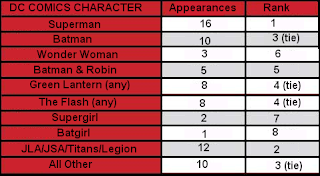
For instance, DC fans and popular culture at large, not to mention many DC Comics creators past and present, playfully debate which hero is more 'super,' Superman or Batman. When we examined just those covers on the list that belonged to superhero comics, Jerry Siegel and Joe Shuster's Superman graced many more covers than Bob Kane's Caped Crusader.  Even taking into account those covers which featured both Batman and Robin, The Boy Wonder, Superman still edged out Batman by one.  


DC Comics' most popular superhero teams, which we defined as Justice League of America, Justice Society of America, the Teen Titans, and the Legion of Super Heroes, as a group also appeared on more covers than Batman himself. 


One interesting fact our data-mining manifested was Wonder Woman's surprisingly poor performance as a DC Comics' 'cover girl.'  The publisher has promoted Superman, Batman, and Wonder Woman to be it's "Holy Trinity" for years, placing them on that high pedestal largely because their three titles endured comics' bleak years post-WWII and thus are the only DC books never to cease publication.  Nevertheless, when it comes to being an icon, Wonder Woman gets her's served on silver platter by both Green Lantern and the Flash.  

Of DC's Top 75 Iconic Covers, only four of that number were non-superhero comics. None of DC's romance or humor comics made the list, nor did any of their licensed property titles.  We noticed only one comic cover less than five years old, and roughly two-thirds of all the covers on the list were published before 1970. A select group of artists and writers were responsible for more than one of the iconic covers  on the list, including, of course, the creators of Superman and Batman.  Notably, Alan Moore topped the writers list with five of his books' covers represented, including Watchmen #1 and his Batman graphic novel, The Killing Joke.  Frank Miller, the writer of the four-issue and now historic series Batman: The Dark Knight Returns, made the list twice, as an impressive two of that series four total covers made the Top 75.  Neal Adams came first in the art department; his pencils graced seven covers. 


Of course, the BIG question on every dabbler's mind right now is which comic book cover claimed the Number One spot.  Could it be a Batman comic? Or did Superman finish first? Maybe neither of them got that coveted ranking - who knows?   Well, we do, and we'd tell you, but we decided to make a game of it instead. 

We selected twelve (12) of the Top 75  covers and lined 'em up in completely random order for you below.  
Your job is to arrange the issues in the way you think they were ranked.  Start with the 'least iconic cover' at the top of your list and work your way down to Number One. You can use every bit of your superhero savvy,  human insight, female intuition, or hell, even a lifeline if you've got one - but really, it's all about fun. 

Since we love you, we are going to give you -- in no specific order -- the actual rankings of the comics below. They might not be too much help now, but then again, you never can tell.  And so, in random order, the rankings of the comics below are:  1,2 3, 5, 8, 10, 11, 12, 24, 26, 28, and 33. 

Got 'em? We'll be back with Understanding The Iconic: Top 75 Covers of DC Comics - Part II this Tuesday. And we'll have your answers then. 


17 December 2009

Alan Moore Should Watch Saturday Morning Cartoons

Last night's comicsblog debut of The Amazing Adventures of Little Batman had everyone talking about serious superheroes around the Home Office water cooler this morning. Any discussion by enlightened individuals about 'serious' and 'superheroes' will, sooner than later, involve Watchmen. Ours did, but then again, we also had a good laugh over Tiny Titans. Hmmm...
Back in 1987, when Alan Moore and Dave Gibbons wrapped up their original twelve issue Watchmen series at DC, the comics industry didn't really know just how serious superheroes could be, at least without losing the traditional characteristics that made them heroes in the first place. Moore and Gibbons changed that way of thinking, and opened the doors to storytelling possibilities that have since become the standard. And while most of them don't reach Moore's complexity or inverted heroism -- aspects that Zack Snyder captured so well with his Watchmen adaptation and which we believe may be the reasons some viewers found the film difficult -- comic book storylines, the heroes and villains and their worlds at large, are darker, grittier, and far more visceral. [Need a big-screen Watchmen refresher? Movie trailers and more can be found here. -- Courteous 'Dabbler]
You betcha, Alan Moore is as serious a fellow as his work might lead you to believe. Just how serious is a topic rich enough for a blog of its own (that gives us an idea!), but the short answer would be too serious. But pull past his thickly out-of-of-control beard and the fact that he worships an ancient Roman snake deity, take Lost Girls only at face value while considering many of his problems with Hollywood and the adaptations of his comics stem not from their quality but his own naivety, and what you have, dabblers, is a little boy. Really, it's true. Alan Moore's a little boy deep-down, one who quite respectably found his genius in comic books.
So when the Home Office's faithful neighbor Raley laughed and snorted about how funny it would've been if Zack Snyder's Watchmen interpretation ended up being a cheesy Saturday morning cartoon full of pizza, pastels, and a talking pink Bubastis, I nearly s%@! myself!
You will, too, when you get a peek at Happy Harry's inspired and frakkin' hilarious satire, Saturday Morning Watchmen. He skillfully twists so many of Watchmen's darkest moments and themes into campy and cuddly kiddie-fare so brilliant even Moore would have to laugh. We all know he could use a good one. Alan, check this out, buddy. Happy Harry's 'toon is serious superhero slapstick at its finest, your Saturday mornings will never be the same.
Was Saturday Morning Watchmen just too funny, or did it take up too-much space on the comicsblog? Are we being unfair to Sir Alan Moore, or have we been way too gentle? (We'll always be respectful, but talent's just part of the picture.) Abbracadabbling wants you - our dabblers and faithful comicsblog followers - to be a BIG part of our picture. So get talking and get involved!! Leave us your Back Issues today!!