The educational abilities of comic books brought the industry much unwarranted attention in the early 1950's, forcing the majority of publishers at the time to either close-up shop or adhere to the guidelines of the newly-formed Code of the Comics Magazine Association of America Inc, or the Comics Code Authority. In the aftermath, comics' ability to teach young readers became diluted if not forgotten as the age of their readership slowly climbed towards the adult.
Yet even for their mature readers, comics' just-as-mature themes and story lines , especially those of 'War Story' comics, often offer comprehensive educations as a by-product of the research that drives their narratives and references their artwork.

Authenticity may be the hallmark of contemporary comics, but the truth hasn't always been so well represented. Yet despite the social conscience and even the critical acclaim they've achieved today, war-themed comics have never been as popular as they were. sixty years ago. Superheroes exploded onto the comics scene just prior to World War II, and it didn't take them long to bring their fight straight to the Axis. Superman, Uncle Sam, the Black Terror, and their compatriots embodied the American ideal, a message so meaningful that it drove comics readership into the hundreds of thousands. And those numbers weren't just kids; for much of the 1940's, American GI's comprised the second -highest demographic of comic book buyers.
Much has changed since those days, including content. The ubiquitous racial stereotypes of comic book villains that once served as excellent propaganda and brought tremendous support for the war effort are gone. And the battles once waged by Captain America and Captain Marvel, Jr are now fought by more realistic protagonists - mortal heroes that can die. For a terrific review of comic books during World War II, read Alex Ness' essay Fighting The Wars with Four-Color Comics - here.
One exception to our generality above was canceled before ever being published: American Power, the intended 2004 Free Comic Book Day submission from now-bankrupt comics publisher CrossGen Entertainment. In all-out Captain America style, the comics' titular hero gives Osama bin-Laden what he's had coming since September 11th, 2001. But times have changed; even if CrossGen had published Power, chances are very good that it wouldn't have been around long.

That's not to say that comic books aren't involved with the War On Terror or even the pursuit of the Taliban; they're instrumental, but they're not published by the mainstream American comics industry.
David Axe, Jonathan Hughes, and Matt Bors are the creators of War Is Boring, a comic strip written by Axe based on his experiences as a war correspondent. Their blog site, also War Is Boring and on which the trio is joined by several other writers and comics journalists, recounts their very real and live-time experiences in Africa, Afghanistan, and other geographies where the United States military is currently involved. Among other things, War Is Boring provides a unique and fascinating look at conflict, US foreign policy, and the use of comics to provide non-fiction accounts of real-world events.
a comic strip written by Axe based on his experiences as a war correspondent. Their blog site, also War Is Boring and on which the trio is joined by several other writers and comics journalists, recounts their very real and live-time experiences in Africa, Afghanistan, and other geographies where the United States military is currently involved. Among other things, War Is Boring provides a unique and fascinating look at conflict, US foreign policy, and the use of comics to provide non-fiction accounts of real-world events. 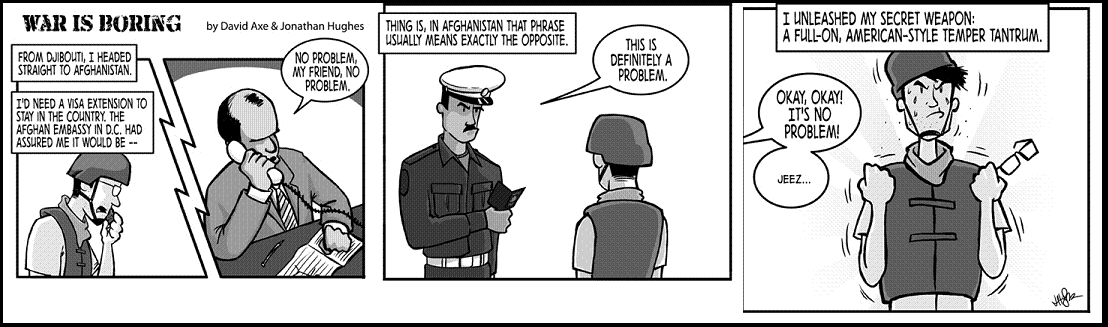
Just over a week ago, Axe posted to his blog the photo at the top of our's - a 'Commando Comic Book - which he snagged a copy of while accompanying the Afghani troops on a commando air assault near the hot-spot of Bagram. Apparently, Afghan commandos give out watercolor comic books to illiterate villagers when they drop in for missions, all in an effort to help explain the role and purpose of the security forces to everyday Afghan citizens. If not on American soil, comic books are recognized as educational tools, if only by a population that's never known them as entertainment.
Visit War Is Boring here.